The Grief No One Names: Pastoral Care for the Losses That Defy Easy Mourning

There is a kind of grief that arrives quietly, without ceremony. No obituary announces it. No one organizes a meal train. The person carrying it may not even possess the language to describe what they feel, only a persistent, hollow ache that does not yield to the ordinary rhythms of comfort the Church typically offers.
This is the grief of estrangement—of a daughter who has not spoken to her father in eleven years and does not know how to mourn the man who died last spring. It is the grief of the pastor who spent three decades building a congregation and now, retired and largely forgotten, mourns the loss of a calling that once defined every waking hour. It is the grief of the couple who finally stopped pursuing fertility treatments, burying a future they had imagined in extraordinary detail. It is the grief of the man whose marriage ended not in betrayal or cruelty but in a slow, quiet dissolution that left him uncertain whether he was even permitted to be sad.
Ambiguous loss, a term first developed by family therapist Pauline Boss, describes mourning that occurs in the absence of clear social recognition or resolution. The Church, for all its rich tradition of pastoral care, has often struggled to honor this category of sorrow. We are, by our liturgical nature, drawn toward resolution—toward resurrection, toward healing, toward the promise that weeping endures only for a night. That theological instinct is not wrong. But when it causes us to rush the grieving toward closure before they have been permitted to fully lament, we risk doing profound harm.
What the Psalms Know That We Have Forgotten
The Hebrew tradition of lament offers the Church its most honest resource for accompanying complicated grief. Nearly a third of the Psalms are classified as laments—raw, unresolved cries directed at a God who is addressed precisely because the speaker is not yet at peace. Psalm 88 is perhaps the starkest example. It ends not in praise or resolution but in darkness: "Darkness is my closest friend." No tidy bow. No pivot to gratitude. Simply an anguished soul telling the truth.
This matters enormously for pastoral practice. When a congregant comes forward carrying grief that does not fit the standard script—when they are mourning a parent who abused them, or a friendship that ended in betrayal, or a version of themselves they once believed they would become—the Church's first obligation is not to explain, reframe, or comfort. It is to bear witness. To say, with the full authority of Scripture behind us, that lament is not a detour on the road to faith. It is an act of faith.
The Particular Weight of Relational Ambiguity
Estrangement represents one of the most spiritually complicated forms of grief a congregation member may carry. When someone is cut off from a sibling, a parent, or an adult child—whether by their own choice or another's—they live in a state of perpetual unresolved mourning. The person is alive, yet absent. Reachable in theory, yet unreachable in practice. There is no funeral to attend, no defined period of bereavement, no community permission structure that says: you are allowed to grieve this.
Well-meaning church communities can inadvertently deepen that wound. Emphasis on family reconciliation, while theologically sound in many contexts, can communicate to the estranged congregant that their situation is a spiritual failure requiring correction rather than a wound requiring care. Sermons on forgiveness, however faithful in intent, can feel like indictments to someone who has forgiven but still chosen, for reasons of safety or health, not to restore contact.
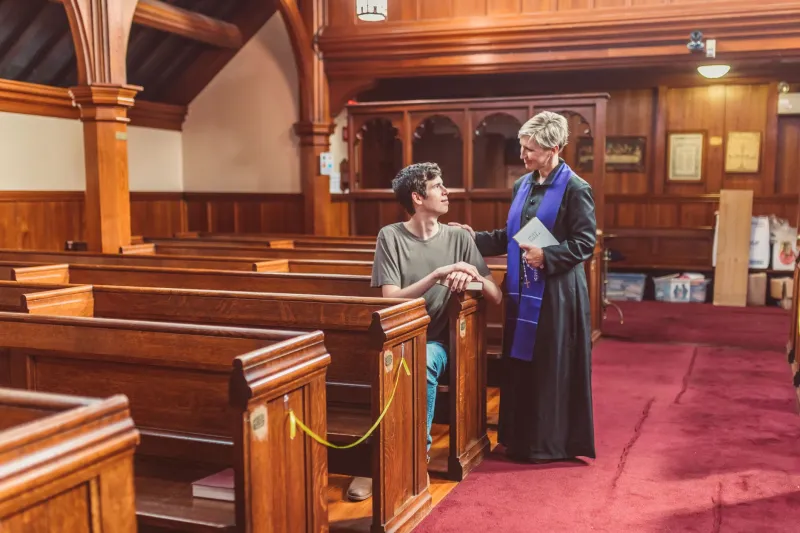
Pastoral wisdom here requires restraint. Before offering a theological framework, the shepherd must understand the terrain. Listening without agenda—without moving immediately toward a prescribed outcome—is itself a profound act of ministry.
Grief Over Identity, Vocation, and Dreams Deferred
Beyond relational loss, congregations must also make room for what might be called existential grief: the mourning that accompanies the death of a long-held identity or a future that will never arrive.
The retired pastor who no longer occupies a pulpit. The athlete whose career-ending injury arrived at thirty-two. The woman who spent her thirties building a business that ultimately failed. The man who surrendered a dream vocation to meet family obligations and has quietly mourned that choice for twenty years. These are real losses, and they carry genuine spiritual weight. Yet because they do not involve the death of a person, they are rarely acknowledged within congregational life.
The Church has an opportunity here that few other institutions possess. Because we believe human beings are made in the image of God—that our longings, our callings, and our identities bear sacred significance—we are uniquely positioned to say: what you have lost mattered. Your mourning is legitimate. You do not need to minimize it in order to be faithful.
Congregational Practices That Honor the Full Spectrum of Grief
Moving from theology to practice, congregations can take several concrete steps to become communities where ambiguous and complicated grief is genuinely welcomed.
Create named space for lament in worship. Incorporate lament psalms and honest prayers of sorrow into regular liturgy, not only during Advent or Holy Week. When grief is normalized in corporate worship, individuals feel less isolated in their private mourning.
Train lay leaders in grief literacy. Most congregations have deacons, elders, or small group leaders who serve as first responders in pastoral care. Equipping these individuals with basic knowledge of ambiguous loss, disenfranchised grief, and trauma-informed listening dramatically expands the congregation's capacity to care well.
Resist the impulse to fix. Establish a congregational culture—modeled from the pulpit and reinforced in small group settings—that values presence over resolution. Job's friends were at their most faithful when they sat with him in silence for seven days. They caused harm when they began to speak.
Offer grief support that does not require a death certificate. Many congregations run bereavement groups that are implicitly or explicitly limited to those who have lost a loved one to death. Consider expanding that circle to include those mourning estrangements, health losses, vocational transitions, and other forms of significant loss.
Preach the full counsel of Scripture on sorrow. When pastors preach honestly about grief—including their own—they give their congregations permission to be honest about theirs. The pulpit is one of the most powerful tools available for reshaping a congregation's emotional and spiritual culture.
Sitting With the Unnamed
In Matthew 25, Jesus speaks of those who were hungry, thirsty, estranged, naked, sick, and imprisoned—the ones whose needs were visible to him even when invisible to the surrounding world. There is a grief that belongs in that company: the sorrow that goes unannounced, uncelebrated, and uncomforted because no one has yet given it a name.
The Church's calling is not only to serve those whose suffering is legible to the broader culture. It is to develop the spiritual attentiveness to see what others overlook—to sit beside the congregant who smiles through the passing of the peace while carrying a weight that has no funeral, no casserole, and no card.
That kind of ministry does not require a program or a budget line. It requires the willingness to ask a harder question: what are you mourning that no one else knows about? And then—perhaps most importantly—to remain in the room long enough to hear the answer.