Sacred Ground or Squandered Gift? How Churches Must Reckon With Their Role in the Housing Crisis
There is a particular kind of discomfort that settles over a congregation when it is asked to look inward rather than outward. It is far easier to organize a coat drive for unhoused neighbors than to ask whether the vacant parsonage three blocks from the sanctuary—sitting empty for a decade while rents in the surrounding neighborhood have doubled—might itself be part of the problem. Yet that harder question is precisely the one that faithfulness demands.
Across the United States, religious organizations collectively own an estimated $500 billion in real estate. Churches, denominations, and faith-based institutions hold parcels of land, aging educational wings, former rectories, and endowed properties that were donated by previous generations with the expectation that they would serve the community. In too many cases, those assets have become liabilities—not merely financial ones, but moral ones—as the communities surrounding those properties sink deeper into housing insecurity.
Matthew 25 is unambiguous: how we treat the hungry, the stranger, the naked, and the sick is how we treat Christ himself. Housing is not peripheral to that mandate. It is central.
The Uncomfortable Arithmetic of Church Property
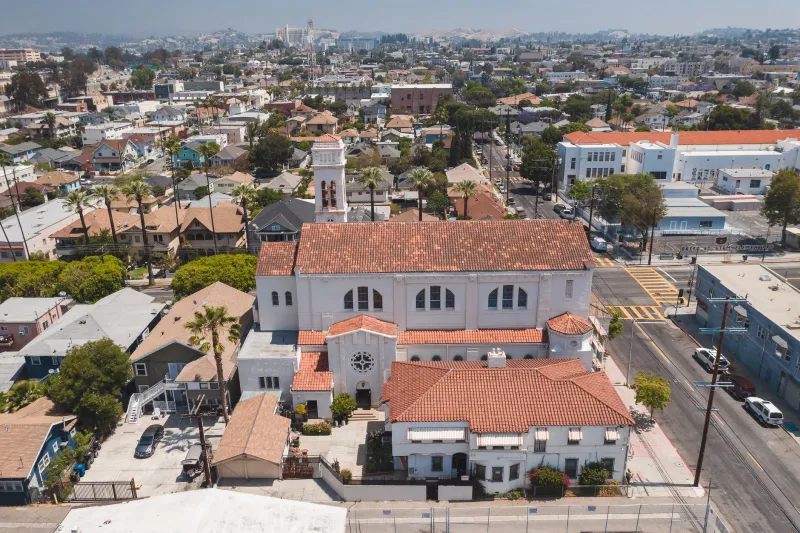
Consider what a typical congregation may hold without fully recognizing its significance. A parsonage that no longer houses a minister, leased at market rate to generate income for the general fund. A fellowship hall used six hours per week while a family shelter two miles away turns away dozens of people each night. A large endowed lot on a desirable street, held in trust and generating modest returns while developers court the board with offers that would displace the very low-income tenants currently living nearby.
None of these situations necessarily reflects malice. Church boards are often composed of well-meaning people navigating genuine fiduciary obligations, aging infrastructure, and limited staff capacity. But good intentions do not absolve a community from examining outcomes. When a congregation's real estate practices—however inadvertently—contribute to displacement, price escalation, or the warehousing of land that could shelter human beings, the body of Christ has a responsibility to take notice.
The biblical concept of stewardship does not permit passive management. The parable of the talents in Matthew 25:14–30 condemns not wickedness but timidity—the servant who buried what he was given rather than putting it to work. Churches that allow properties to sit vacant, or that extract maximum market rents from vulnerable tenants without regard for their capacity to pay, are burying the talent.
Principles Before Programs: What Scripture Demands
Before any congregation can design a practical response, it must be grounded in the theological convictions that make that response necessary rather than merely strategic.
The Hebrew concept of jubilee, described in Leviticus 25, envisions a society in which land is never permanently alienated from those who need it most—a radical check against the accumulation of property at the expense of the poor. The prophets, particularly Micah and Amos, reserve some of their sharpest language for those who acquire house after house and field after field while the vulnerable are dispossessed. And the early church in Acts 4 is described as a community in which no one claimed exclusive ownership of goods, and distribution was made according to need.
These are not proof texts to be deployed carelessly. They are, however, a consistent thread in the biblical witness: property is held in trust, not in perpetuity, and its highest use is always the flourishing of the neighbor.
Conducting an Honest Property Audit
Practical transformation begins with honest accounting. Congregations serious about this work should consider convening a small task force—ideally including both board members and community members who live in proximity to church-owned properties—to conduct a structured review. That review should address at minimum the following questions:
What do we own, and what are we doing with it? A full inventory of all church-controlled real estate, including properties held by associated foundations or denominational bodies, is essential. Many congregations discover they hold more than they realized.
Who benefits from our current use of these properties? If the primary beneficiary of a leased parsonage is the general operating fund rather than a family in need of stable housing, that is worth naming plainly.
What are the housing conditions in our immediate neighborhood? Local data on vacancy rates, median rents, eviction filings, and shelter capacity should inform every property decision a congregation makes. Organizations such as the National Low Income Housing Coalition publish county-level data that can serve as a starting point.
What restrictions, if any, govern our use of these properties? Deed restrictions, denominational policies, zoning regulations, and the terms of endowments may limit options—but they rarely eliminate them entirely. Understanding the actual constraints is different from assuming that constraints exist.
Models Worth Emulating
Faith communities across the country have already begun to answer these questions with creativity and courage.
In California, several Episcopal and Lutheran congregations have partnered with community land trusts to develop affordable housing on church-owned parcels, retaining ownership of the land while transferring long-term leases to housing nonprofits. This model preserves the congregation's stewardship role while dramatically expanding the number of families served.
In the Midwest, a network of urban churches converted underutilized educational buildings into transitional housing for families exiting homelessness, partnering with local social service agencies to provide wraparound support. The congregations did not become social service providers themselves; they became hosts—a role the New Testament knows well.
In the South, several historically Black churches have used their considerable land holdings as leverage in negotiations with city governments, trading development rights for guarantees of affordable unit percentages in new mixed-income projects. These congregations understood that their property was not merely a resource but a form of power, and they deployed that power on behalf of those with none.
None of these models is without complexity. Each required patient negotiation, legal counsel, community input, and a willingness to accept outcomes that were less financially optimal than a market-rate sale. Each also produced something that no financial return can replicate: the lived experience of a congregation that took its theology seriously enough to let it cost something.
The Question the Congregation Must Ask Itself
There is a moment in every genuine discernment process when the comfortable framing—"How can we help those in need?"—must give way to a more searching one: "In what ways have we, however unintentionally, contributed to the need that surrounds us?"
For congregations with significant property holdings, that question is not rhetorical. It has a physical address. It has a lease agreement. It has a board resolution and a line item in the budget.
The Matthew 25 vision of ministry is not only about generosity extended from a position of comfort. It is about the transformation of the giver as much as the receiver—about communities willing to examine their own complicity in the conditions they seek to alleviate, and to offer not merely their surplus but their very ground.
The land beneath the sanctuary was always meant to be holy. The question before the church today is whether it will allow that holiness to extend to every parcel it holds—and every neighbor whose housing security depends on what the congregation decides to do next.