Wounded by the Shepherd: How Congregations Can Become Places of Refuge for Survivors of Spiritual Abuse

There is a particular kind of wound that the church seldom discusses openly — the wound inflicted in God's name. For millions of Americans, the deepest spiritual injuries they carry were not dealt by indifferent culture or hostile circumstance. They were delivered from the pulpit, the elder's board, the small group leader's chair. They arrived dressed in scripture and wrapped in the language of love.
Spiritual abuse — broadly understood as the misuse of religious authority to control, shame, manipulate, or harm individuals — is neither rare nor confined to headline-making scandals. It occurs across denominations, in large congregations and small ones, in communities that would be horrified to recognize themselves in the description. And those who survive it frequently walk away not merely from a particular church, but from any congregation at all, carrying with them a fractured relationship with God, community, and their own spiritual instincts.
For those of us who take Matthew 25 seriously — who understand that serving Christ means seeking out the overlooked and the wounded — this population of believers demands our attention. The question is not simply whether our churches are willing to welcome them. The question is whether we are willing to do the harder work of becoming the kind of communities they can actually trust.
Understanding What Spiritual Abuse Actually Looks Like
Before any congregation can serve survivors well, its leadership must cultivate a clear-eyed understanding of what spiritual abuse involves. It is not merely harsh preaching or theological disagreement. It encompasses a recognizable pattern of behaviors: the weaponization of scripture to enforce compliance, the suppression of legitimate questions or dissent, the cultivation of unhealthy dependence on a leader's authority, the use of shame and fear as instruments of control, and the systematic discrediting of those who raise concerns.
Survivors often describe an experience in which the normal mechanisms of accountability were either absent or actively dismantled. Leaders were placed beyond question. Doubt was reframed as spiritual failure. Leaving was treated as betrayal — of God, of community, of one's own salvation.
These patterns leave lasting marks. Research on religious trauma increasingly documents symptoms that parallel those associated with other forms of institutional abuse: hypervigilance, difficulty trusting authority figures, grief, shame, and profound disorientation about one's own spiritual identity. A person who has experienced this kind of harm does not simply need a warmer welcome on Sunday morning. They need communities that have genuinely interrogated their own structures and earned the right to be trusted.
The Biblical Mandate for This Work
The prophetic tradition of scripture is unambiguous about the gravity of leadership that exploits rather than serves. Ezekiel 34 offers one of the most searching indictments in the entire canon, directed at shepherds who have fed themselves while scattering and neglecting the flock. The passage does not soften its language: God declares that He is against such shepherds and will hold them accountable.
Jesus Himself reserved His most pointed words not for Roman occupiers or irreligious crowds, but for religious leaders whose authority had become an instrument of burden rather than liberation. "They tie up heavy burdens," He observed, "and lay them on people's shoulders, but they themselves are not willing to move them with their finger" (Matthew 23:4).
The call to welcome and restore those wounded by misused religious authority is not a peripheral ministry concern. It sits at the center of what it means to embody the Kingdom of God — a Kingdom characterized, above all, by justice, mercy, and the restoration of human dignity.
Auditing Your Own House
Perhaps the most uncomfortable truth congregations must confront is this: the same dynamics that produce spiritual abuse in other communities can exist, in nascent or advanced form, in their own. Genuine care for survivors begins not with programming directed outward, but with honest institutional self-examination.
Church leadership teams should periodically ask themselves difficult questions. Are dissenting voices genuinely welcomed, or quietly marginalized? Are accountability structures for pastoral leadership robust and independent, or largely ceremonial? Are congregants encouraged to engage scripture and faith with intellectual honesty, or is doctrinal conformity enforced through social pressure? Are those who choose to leave treated with dignity, or subjected to informal shunning?
This kind of audit is not an act of institutional self-flagellation. It is an act of faithfulness. Communities that have done this work honestly are far better positioned to offer genuine refuge to those who have been harmed, because they can speak with credibility rather than mere aspiration.
Training Leadership to Recognize the Signs
Pastors, elders, deacons, and lay leaders who may encounter survivors need specific preparation — not simply generalized pastoral sensitivity, but literacy in the particular dynamics of religious trauma. Many well-meaning church leaders inadvertently re-wound survivors by minimizing their experiences, urging premature forgiveness, or reflexively defending the institutions that caused harm.
Training should include familiarity with the common presentations of religious trauma, an understanding of why survivors may exhibit what appears to be disproportionate distrust of spiritual authority, and clear guidance on when to refer individuals to licensed mental health professionals with relevant expertise. Several organizations, including those specializing in faith-based trauma recovery, offer resources and training curricula that congregations can adapt for their contexts.
Equally important is the cultivation of a culture in which survivors feel no pressure to perform recovery on any particular timeline. Healing from spiritual abuse is rarely linear. It is frequently interrupted by grief, anger, and profound theological questioning. A congregation that can hold space for that complexity — without rushing toward resolution — offers something genuinely rare and genuinely valuable.
Building Structures That Demonstrate Trustworthiness
For a survivor of spiritual abuse, trust is not extended on the basis of stated intentions. It is extended — slowly, conditionally, and often with considerable ambivalence — on the basis of demonstrated behavior over time. Congregations serious about this ministry must therefore focus on structural transparency as much as relational warmth.
Practical steps include establishing clear, accessible grievance processes that allow any member to raise concerns about leadership conduct without fear of retaliation. They include publishing financial reports and governance documents in formats that ordinary congregants can actually understand and access. They include ensuring that no single leader, regardless of charisma or tenure, operates without meaningful oversight.
They also include, critically, the willingness to acknowledge institutional failure when it occurs — and to pursue accountability rather than institutional self-protection when harm has been done. Nothing communicates trustworthiness to a survivor more powerfully than witnessing a community choose integrity over reputation.
A Ministry of Patient Presence
The work of welcoming those wounded by spiritual abuse will not yield rapid, visible results. It will not fill pews quickly or generate compelling testimony for the annual report. It is, in many respects, the quietest and most demanding form of ministry — a long obedience of structural faithfulness, cultural humility, and patient presence with those whose trust has been profoundly violated.
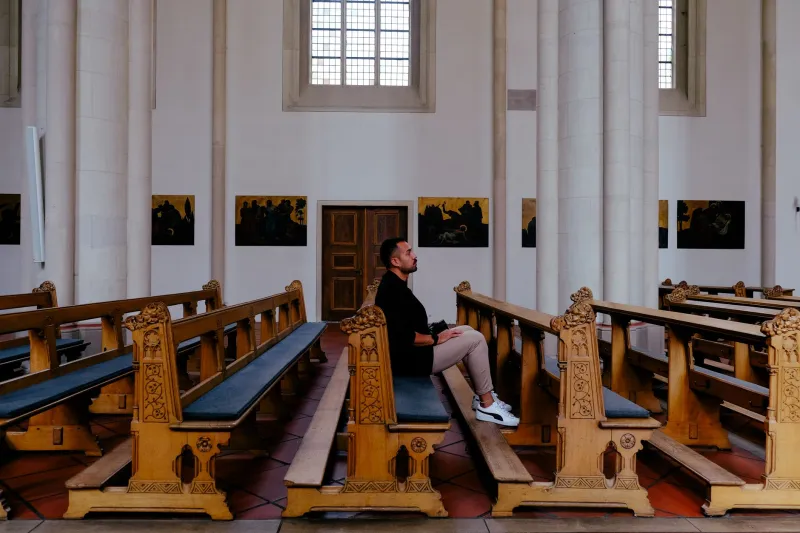
But this is precisely the work to which the parable of Matthew 25 calls us. The hungry, the stranger, the one who is sick and imprisoned — these are not abstractions. They include the believer sitting in a coffee shop on Sunday morning, unable to walk through a church door, carrying wounds that most congregations have never thought to address.
To reach them is not merely a matter of compassion, though compassion is essential. It is a matter of justice — the justice of a God who is against every shepherd that has scattered and exploited His flock, and who calls His people to gather what has been driven away, to bind up what has been broken, and to strengthen what has been sick.
That is the ministry before us. It begins, as all genuine ministry does, with the willingness to see.